Your web browser is out of date. Update your browser for more security, speed and the best experience on this site.

Update your browser

Articles August 31, 2026

2026 Executive Research: Why AI Stalls

CapTech
Author
CapTech

Across hundreds of IT decision-makers, CapTech's 2026 Executive Research found a consistent pattern: organizations are investing in AI with confidence, but progress often hinges on operating decisions made too late in the AI lifecycle.

4 Decisions Leaders Can’t Afford to Delay

This friction shows up most clearly in four areas: success metrics, stakeholder alignment, legacy integration, and governance. Each decision shapes whether AI creates measurable value, gains organizational support, fits into the technology environment, and remains accountable once it’s live.

These four decisions appear in every modernization effort. AI makes them continuous. Output falls within a range rather than landing on a fixed result, so “working” becomes a threshold the organization defines and tests. The model is licensed rather than owned, and even a pinned version carries a retirement date set by the provider. Each new capability can change what the system can do and what the organization must decide.

Agents raise the stakes further. As AI systems move from answering questions to taking action, each decision expands. Success becomes a completed task rather than a correct response. Alignment defines which actions the system may take without approval. Integration determines what it can access and change. Oversight creates the record of what it did, why it acted, and whether the result met the organization’s standards.

AI makes the cost of leaving them open rise with every release.

Download the Full Research

Learn More

The four decisions remain.

CapTech's research points to a practical challenge for AI leaders. Operational decisions are often treated as secondary to technical execution, then become more expensive to resolve once systems, teams, and expectations are already in motion. 


The timing matters, but so does preserving room to adjust as AI capabilities change. Some decisions become more expensive when deferred. Others create more value when they can be revisited as requirements, models, and capabilities evolve. The challenge is deciding clearly enough to move forward while preserving the flexibility to adapt as technology evolves.

Framework graphic titled ‘Decision Discipline Every Release’ showing four governance principles for AI systems arranged around a circular process. Step 1, Define Success: What does ‘working’ mean? Own the evaluation set, set the release threshold, and connect performance to business value. Step 2, Align Authority: Who may decide and act? Set the autonomy boundary, name output accountability, and identify the quality bar arbiter. Step 3, Preserve Optionality: What can be changed later? Create a replaceable model boundary, keep critical steps deterministic, and carry permissions through the system. Step 4, Maintain Oversight: How will the system stay accountable? Log behavior and watch performance, keep a named owner on watch, and define the trigger and fallback.

The four decisions remain.

CapTech's research points to a practical challenge for AI leaders. Operational decisions are often treated as secondary to technical execution, then become more expensive to resolve once systems, teams, and expectations are already in motion. 


The timing matters, but so does preserving room to adjust as AI capabilities change. Some decisions become more expensive when deferred. Others create more value when they can be revisited as requirements, models, and capabilities evolve. The challenge is deciding clearly enough to move forward while preserving the flexibility to adapt as technology evolves.

A decision made while a pilot is still flexible can clarify the work ahead. The same decision made later requires teams to rework architecture, renegotiate ownership, or rebuild measurement after the fact. The price of indecision climbs the longer it waits.

Every phase in the AI lifecycle offers an opportunity to course correct: identify the next decision that matters, make it explicit, and carry it forward as the initiative evolves. This decision discipline accelerates progress and improves AI outcomes. 

Why AI Stalls in the Same Four Places

The same four decisions appeared repeatedly in the research, and they live in the gap between technical capability and business value. These decisions define what success means, who has authority, how AI connects to existing systems, and how performance is monitored after deployment. 

The priority rankings reveal why they’re deprioritized: more visible technical concerns rise first. Security and compliance ranked as top-two priorities for 48% of IT decision-makers. Clear return on investment at 38%, cloud computing 32%, and data architecture at 30%. The operating decisions that most frequently determine execution sat lower, with governance, stakeholder alignment, and legacy compatibility clustered at 24% to 27%.

The risk rankings tell the other side of the story. Unaligned stakeholders were named as a top derailer by 28% of respondents. Legacy integration surfaced as a risk to progress for 26%. And governance approval was cited by 41% as a point where initiatives stall or reverse.  

This data uncovered a real blind spot: the decisions that leaders ranked as lowest priorities are their highest risks to AI progress.

The Pattern Runs Deep

The priority-to-risk inversion extends further. Adoption rises from 10% priority to 22% risk. Tech debt ranks as a top-two priority for only 9% of respondents, yet 29% cite it as a risk to progress. When the same pattern repeats across multiple topics, it points to an operating challenge rather than an isolated oversight.

AI programs tend to focus early attention on visible technical work. Less visible decisions about ownership, incentives, measurement, and operating constraints receive less attention, until they begin to affect progress.

The Cost of Late Decisions

Every AI lifecycle includes decision phases that either reduce uncertainty or carry it forward. The real cost of these decisions increases as an initiative moves from concept to pilot, from pilot to production, and from production to scale. Early decisions can still shape the build. Later decisions often become more expensive by requiring teams to adjust what has already been built, agreed to, or measured.

CapTech’s research found a late decision-making pattern across all four areas:

1. Success metrics

are often decided after programs are already underway. Over a third of teams define at-scale key performance indicators in-program.

2. Stakeholder alignment

is settled later still, remaining unresolved until production for 38% of organizations.

3. Legacy integration

and tech-debt decisions are spread across every phase, and they’re rarely concentrated early enough to guide architecture.

4. Governance

waits the longest. A majority of IT decision-makers said their organizations delayed defining AI governance until systems were already live or close to production.

Rework Tax

Technical debt reflects the cost of choices embedded in technology. Rework tax is its operational counterpart: the time, budget, and attention teams spend revisiting work because a consequential decision remained unresolved. As an AI initiative advances, that tax appears in rebuilt measurement, renegotiated ownership, revised architecture, and governance added after deployment. Every delayed decision adds to the bill.

But AI creates a second cost. Some decisions are made too rigidly and have to be revisited when models, economics, or capabilities change. The goal isn't simply to decide earlier. It's to decide clearly enough to move forward and flexibly enough to adapt when conditions change.

The Cost of an Unresolved Decision Rises After Each Commitment

AI teams pay a rework tax when measurement, ownership, architecture, or oversight must be rebuilt after the work has advanced.
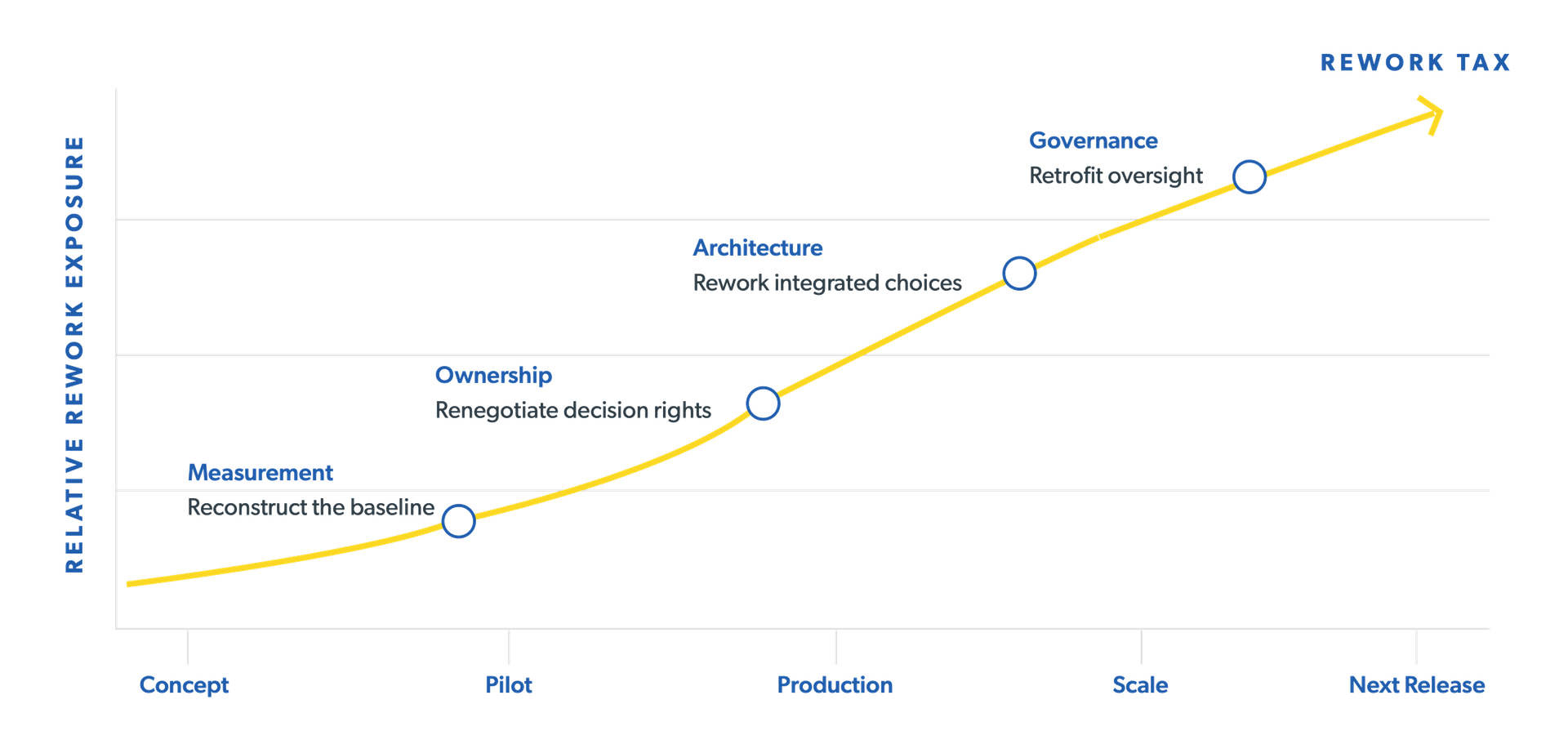
Rework tax creates a compounding effect across the AI lifecycle. Metrics added after launch are harder to tie to a clean baseline. Ownership clarified after handoff requires teams to reopen decisions. Architecture adjusted after integration can turn a design choice into rework. Governance added after deployment can protect what is already live, but the organization has less room to build oversight into the system from the start. 

For organizations already in production, the cost curve isn’t fixed. The next release, model update, handoff, or measurement cycle creates another opening to lower the cost of your next decision. It’s never too late to course correct.

Download the Full Research

Learn More

Brian Bischoff

Principal, CTO

Brian leads our business strategy for our practice areas and is a thought leader in digital strategy. He provides an objective perspective through the strategic analysis of current technology trends and designs and builds great experiences for our clients.

LinkedIn Envelope
Bree Basham

Bree Basham

Principal, Go-to-Market & Growth Strategy

As Principal of CapTech’s Go-to-Market & Growth Strategy, Bree Basham leads our efforts to shape how we bring services, solutions, and stories to market—accelerating growth and deepening client impact. Drawing on a career that spans strategy, customer experience, and marketing, Bree brings a rare blend of creative vision and strategic discipline to CapTech’s growth initiatives.

LinkedIn Envelope