Your web browser is out of date. Update your browser for more security, speed and the best experience on this site.

Update your browser
CapTech Home Page

Articles June 18, 2026

How Private Equity-Backed Organizations Move from AI Curiosity to Measurable Impact

Moving from AI Curiosity to Measurable Impact

Private equity and private equity portfolio companies increasingly recognize the potential of AI as a value multiplier to improve operational efficiency, accelerate growth, reduce costs, and scale without adding headcount. Yet many of these companies struggle to move from aspiration to execution in a way that delivers credible and measurable returns.

This engagement story provides a practical model for business and technology leaders seeking to deploy AI responsibly without overcommitting capital, disrupting operations, or chasing hype. 

Anchoring AI in Business Reality

For more than a year, CapTech has partnered with a private equity-owned, multi‑site hospitality client to establish a disciplined, value-oriented approach to AI adoption. 

This client operates a large portfolio of location‑based businesses across the United States, serving more than 400,000 customers through highly localized operations.

Like many PE-backed enterprises that have grown through acquisition, the company faced a familiar set of challenges:

  • fragmented technology platforms,
  • duplicated and disparate data,
  • escalating SaaS costs, and
  • labor-intensive processes that were difficult to scale. 

Alongside these pressures, the organization struggled with defining and executing on AI in a meaningful, impactful way. Leadership understood the potential upside but was cautious about investing without a clear line of sight to value. 

Instead of starting with a pre-baked solution that met a generic business need, CapTech began with a strategic assessment that focused on the client’s operating model, data assets, and cost structure. 

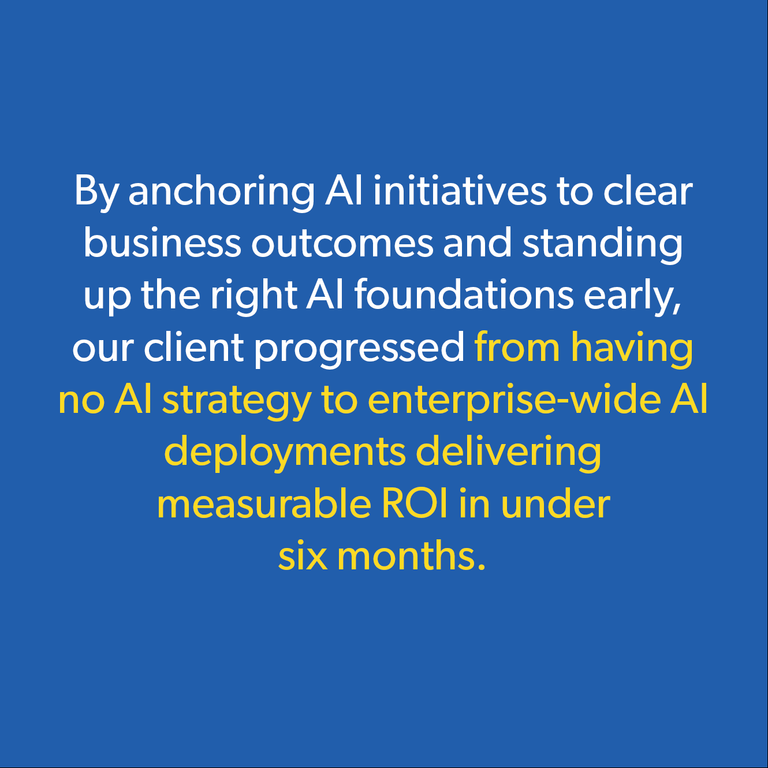
Text graphic on a blue background stating: By anchoring AI initiatives to clear business outcomes and standing up the right AI foundations early, our client progressed from having no AI strategy to enterprise-wide AI deployments delivering measurable ROI in under six months.

The objective was straightforward: identify where AI could meaningfully improve both the top line and bottom line—either by enabling revenue growth, reducing operational friction, or supporting cost takeout initiatives.  

This framing positioned AI as a tool to advance existing business priorities, not a parallel innovation effort. 

Establishing Clear Criteria for AI Investment
Throughout the engagement, CapTech evaluated AI opportunities using a consistent set of criteria designed to support disciplined prioritization in this client’s context. Each AI proof of concept (POC) opportunity needed to have: 

  • Direct value alignment with measurable business outcomes to avoid adding more technology noise and increasing cost
  • Trusted data readiness, focusing on use cases that could easily leverage existing and trustworthy data inputs to ensure credibility
  • Operational fit, to minimize any initial disruption to frontline teams and existing workflows, improving adoption likelihood and reduced organizational friction 

Ideas that lacked a credible value thesis or required extensive change management or operational transformation were deliberately deprioritized. 

This approach enabled leadership to identify costeffective, lowcomplexity opportunities that built both momentum and excitement while also proving out value creation.

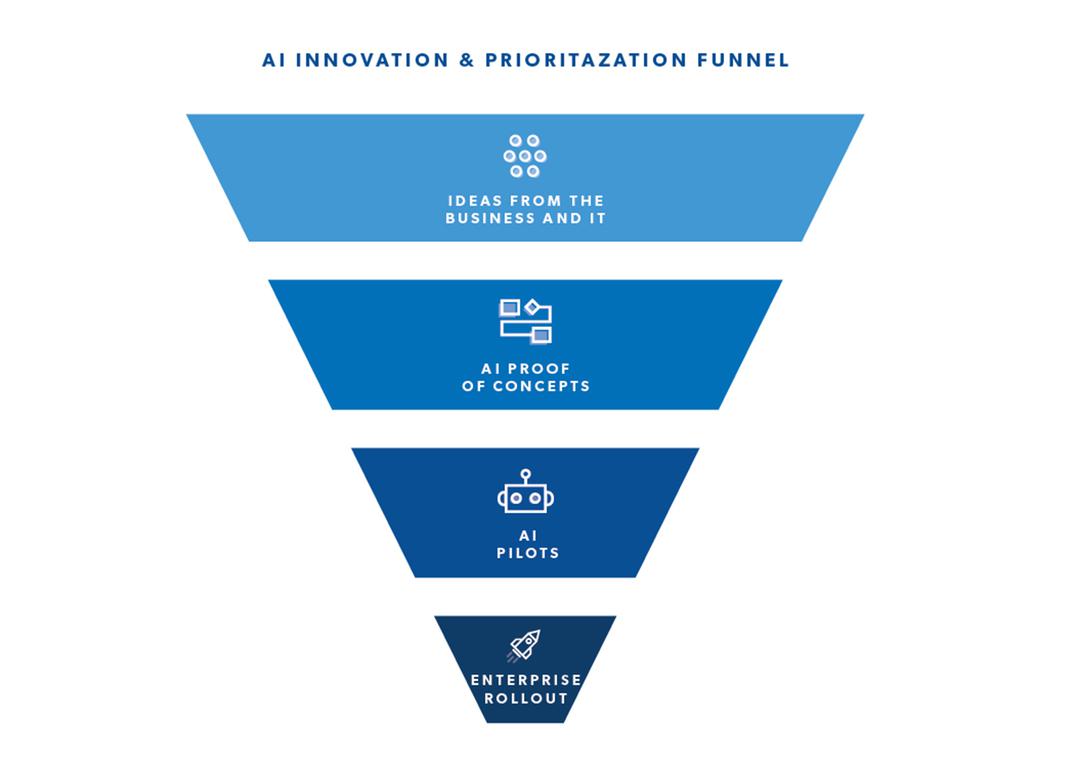
AI innovation and prioritization funnel showing four stages from top to bottom: ideas from the business and IT, AI proof of concepts, AI pilots, and enterprise rollout, with each stage narrowing as it progresses.

Figure 1: AI Innovation & Prioritization Funnel. AI POCs establish reusable capabilities and validate ROI before scale. This approach minimizes risk, avoids disruption, and builds confidence in where AI drives measurable business value.

This funnel shows how we take AI ideas from early concept to enterprise scale in a structured, low-risk way.

It starts with early ideas from across the business and IT, which are hypothesis-driven and lightly vetted. We then move into proof of concepts to quickly validate ROI, feasibility, and what it takes to scale.

The strongest opportunities advance to pilots, where we test real-world impact, gather feedback, and uncover operational or adoption challenges.

Finally, successful pilots move into enterprise rollout, where solutions are fully built, secure, and standardized to scale across the organization.

Learning Through Deliberate Experimentation
Prioritized POCs were greenlit for rapid development to validate assumptions, feasibility, and ROI before committing to larger business and IT investments. Not every POC landed. For example, one early prototype demonstrated technical results but failed to gain traction with business stakeholders.

While that POC never moved to a pilot phase, the lessons learned, cost estimates, business constraints, change management constraints, and integration considerations were critical inputs for the next solution. 

Despite the POC being deferred, the “fail fast” model worked—a 4-week technology investment generated a list of learnings and foundational AI architecture decisions that carried through to future solutions.

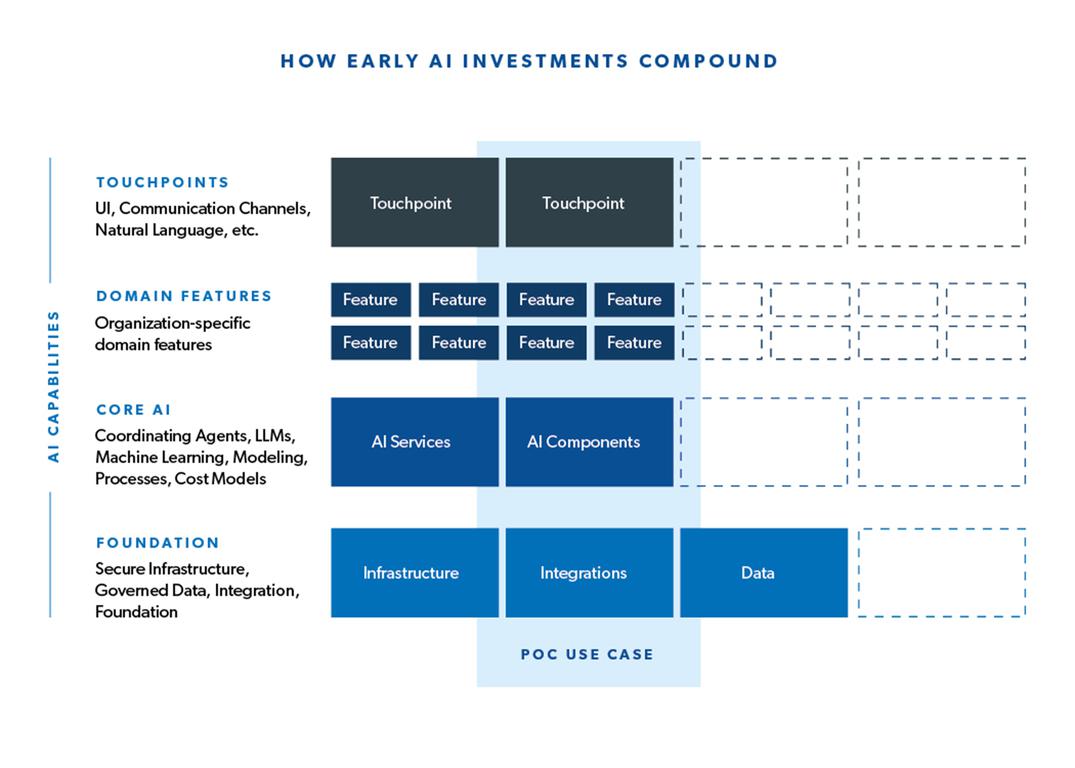
Diagram titled ‘How early AI investments compound’ showing four layers of AI capabilities: foundation, core AI, domain features, and touchpoints. The foundation includes infrastructure, integrations, and data. Core AI includes AI services and AI components. Domain features are organization specific features. Touchpoints include user interfaces, communication channels, and natural language. A highlighted vertical section labeled POC use case demonstrates how early investments build and scale across layers over time.

Figure 2: How Early AI Investments Compound. POCs should produce reusable AI capabilities—not one-off solutions. This approach accelerates future use cases, reduces cost to scale, and compounds ROI over time.

The Inflection Point that Established Momentum

The inflection point came with the development of an AI-powered autoresponder to manage inbound sales and event inquiries. The value creation thesis included increased operational efficiency, increased management visibility, and increased conversion each of the 100+ disparate and unique franchise locations. Using a multi‑agent architecture, the solution delivered personalized, relevant, and context-aware responses tailored to each location’s unique business rules, space availability, amenity offerings, and selling strategy. 

The solution:

  • Automated integrations into existing legacy systems in days (not weeks)
  • Capitalized on low friction, natural language processing technology, and
  • Defined clear value indicators that would make a go/no-go decision quick. 

Within weeks of launching the pilot, the organization recorded measurable results: 

  • Dramatic improvement in inbound lead capture and data completeness (the lead tracking rate went from 42% to 95%)
  • Substantial reduction in prospect response times—from days to minutes
  • Increased conversion rates driven by faster, more relevant engagement  

The defined ROI indicators for the pilot were clear, and as a result, securing executive approval and funding and enterprise rollout was a “no-brainer.”

For leadership, this marked a shift in perception: Within their organization, AI had moved from experimentation to demonstrating a practical, scalable lever for value creation and cost takeout within a legacy and nuanced enterprise architecture in a matter of weeks not months. Following this shift, the team continued to drive AI innovation and maturity – delivering up to 60+ unique AI capability building blocks, multiple successful AI pilots, enterprise deployments, and rapid AI adoption across the enterprise.  

A Repeatable Model for Sustainable AI Adoption
This partnership illustrates an important lesson for private equity and technology leaders alike: meaningful AI impact does not require sweeping transformation from day one.

When AI initiatives are grounded in business strategy and supported by strong foundations, they become a durable source of competitive advantage rather than a speculative bet—especially when organizations build momentum through deliberate, valuefocused starting points.

For organizations seeking to move beyond AI curiosity toward sustained, measurable value, this model offers a pragmatic path forward.

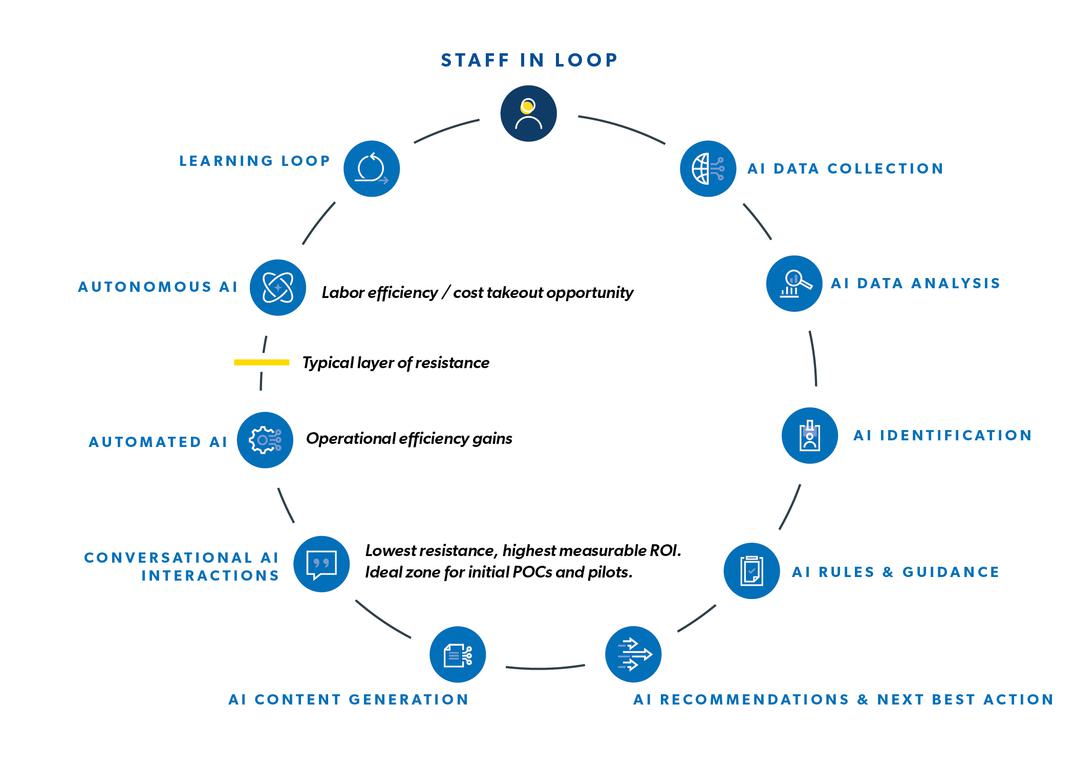
Circular diagram labeled ‘staff in loop’ showing an AI lifecycle: AI data collection, AI data analysis, AI identification, AI rules and guidance, AI recommendations and next best action, AI content generation, conversational AI interactions, automated AI, autonomous AI, and learning loop. The diagram highlights a typical layer of resistance and notes labor efficiency, operational efficiency gains, and areas with lowest resistance and highest measurable ROI for initial proofs of concept and pilots.

Figure 3: AI Capability Model. Organizations don’t need enterprise-scale AI to start. The greatest value is realized by targeting mid-spectrum capabilities where data is available, workflows are stable, and impact is quickly measured.

Where to Start: Turning AI into Operating Leverage

For private equity leaders considering their first steps into AI, the starting point is not a tool or platform. It’s clarity on business objectives. The most effective AI initiatives begin by identifying where performance gaps exist: revenue leakage, labor constraints, slow response times, or inconsistent execution across the portfolio.

From there, the organization can use targeted experimentation to test whether AI meaningfully improves outcomes using existing data and against identified workflows. By treating AI as an extension of core operating strategy—subject to the same investment discipline, value thresholds, and accountability as any other initiative—firms can move quickly, limit risk, and build confidence in where AI truly belongs.

Matthew Torrenzano

Matthew Torrenzano

Technical Director, Private Equity

Matt is a technology leader, strategic advisor, and senior architect with 21 years of experience helping private equity–backed and enterprise organizations define and execute technology strategy across modernization, commerce, data, and AI. He partners with executives to drive growth, cost takeout, and post close transformation, translating investment priorities into actionable architectures and delivering AI enabled solutions at global scale.

LinkedIn Envelope

Jen Maceyko

Director, Distribution & Logistics

Jen is a strategic technology consulting leader with more than 15 years of experience in supply chain, logistics, and business operations. She excels at aligning people, processes, and technology to deliver impactful results. Jen partners with stakeholders to define goals, lead transformation initiatives, and adapt delivery approaches while motivating teams to build strong organizations and achieve sustainable, long-term success.

LinkedIn Envelope